
Enrique Ortegon
If your business depends on fast, reliable connectivity across the US-Mexico border, you’ve probably heard the term “peering” thrown around in conversations with your network provider. It sounds technical, but the concept behind it is simple, and understanding it can help you make smarter decisions about how your company connects to the internet.
The Problem With Traditional Transit
Most businesses reach the internet through a transit provider: an ISP that carries your traffic to its destination, often through several intermediary networks along the way. Each hop adds latency. Each intermediary adds cost. And if one of those networks has an outage, your traffic can slow down or stall, even if your own connection is perfectly healthy.
For companies operating across the US-Mexico border, this matters more than it might elsewhere. Traffic that has to travel long distances through multiple providers before reaching a user in Monterrey, Tijuana, or McAllen picks up delay at every step. For real-time applications, video, gaming, financial transactions, that delay is the difference between a smooth experience and a frustrating one.
What Is Peering?
Peering is a direct agreement between two networks to exchange traffic without going through a third party. Think of it like two neighboring businesses agreeing to share a driveway instead of both routing deliveries through the city’s main road. The traffic moves directly from one network to the other, with fewer hops, less congestion, and lower cost per bit.
Peering can happen in two ways. Private peering is a direct, dedicated connection between two networks, usually justified when there’s a lot of traffic to exchange. Public peering happens at a shared facility where many networks connect to a common switching fabric and exchange traffic with each other through a single physical port. That shared facility is called an Internet Exchange.
Peer with all Mexican networks and content providers directly on the border
Download the MEX-IX brochureWhat Is an Internet Exchange?
An Internet Exchange, or IX, is a physical location, usually inside a carrier-neutral data center, where multiple networks meet to interconnect directly. Instead of each network needing a separate connection to every other network it wants to exchange traffic with, it connects once to the exchange and can reach dozens of other participants through that single port.
This is the infrastructure layer that makes modern peering practical at scale. Content providers, ISPs, cloud platforms, and enterprises all use IXs to shorten the path their traffic takes, and to reduce their dependency on transit providers for local or regional traffic.
Why This Matters for Your Business
The benefits of peering through an IX come down to four things:
Lower latency. Traffic takes a shorter, more direct path, which matters for anything sensitive to delay: video conferencing, cloud applications, gaming platforms, and financial services.
Lower cost. Exchanging traffic directly with the networks your business talks to most reduces the volume you need to pay a transit provider to carry.
More control. Peering lets you decide which networks you connect to directly, rather than relying entirely on a provider’s routing decisions.
Better redundancy. Diversifying how your traffic reaches its destination, through direct peering as well as transit, reduces your exposure to a single point of failure.
For companies operating in border markets, where traffic often needs to move efficiently between the US and Mexico, having access to a well-connected IX close to that traffic can materially change performance and cost.
A Real-World Example: MEX-IX
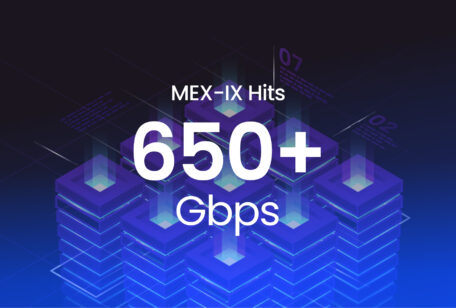
MEX-IX, the Internet Exchange operated by MDC Data Centers in McAllen and El Paso, is a practical illustration of how this works. Carriers, ISPs, and content providers connect to MEX-IX to exchange traffic directly with the other networks present on the platform, rather than routing that traffic through long-haul transit.
Because MEX-IX sits inside carrier-neutral facilities along the US-Mexico border, in McAllen and in El Paso, networks that peer there can shorten the path their traffic takes between US and Mexican markets. It’s a straightforward example of what peering and IXs are built to solve: fewer hops, lower latency, and more control over how traffic moves across a region where connectivity has historically been harder to optimize.
The Takeaway
Peering isn’t a niche technical detail, it’s a foundational decision about how efficiently your business connects to the rest of the internet. Understanding what it is, and where an Internet Exchange fits into that picture, gives you a clearer view of the tradeoffs your network team, or your provider, is making on your behalf.
Want to go deeper? Download our complete guide, A Practical Guide to Peering & Internet Exchanges, for a closer look at peering types, how to evaluate whether your business needs an IX, and a plain-language glossary of the terms you’ll hear along the way.

Questions about peering or MEX-IX?
Talk to our team