

Alberto Caraballo
The US–Mexico digital corridor has evolved. What was once framed primarily as cross-border connectivity is now about distributed, multi-entry architecture built for resilience and long-term scale.
El Paso has become the second-largest interconnection hub along the US–Mexico border. Its role is no longer tactical. It is structural.
That maturation reflects three underlying dynamics.
1. Distributed Architecture Is the Baseline
Path diversity has long been a requirement for global carriers and content platforms. Multiple crossings, independent routes, and traffic engineering flexibility are foundational to serious network design.
What has changed is scale.
As traffic volumes grow and architectures become more distributed, the western corridor carries a larger share of strategically important flows. El Paso provides geographic separation from eastern crossings, reducing concentration risk and strengthening routing options across the border.
This is not about redundancy for its own sake. It is about building architectures that remain stable under load and adaptable under change.
2. Geography Still Determines Performance
Network performance is increasingly software-defined, but it is also physical.
Latency, route distance, and fiber topology continue to shape how traffic moves. El Paso sits at the convergence of Texas, New Mexico, and Chihuahua, aligned with fiber routes linking Dallas, Phoenix, and Los Angeles. For traffic destined for northern Mexico, including industrial hubs in Chihuahua, Sonora, and Durango, western routing often provides a more direct path than eastern alternatives.
Fewer route deviations mean measurable latency differences. At scale, those differences compound.
As distributed strategies mature, corridor optimization becomes part of long-term planning, not an afterthought.
3. Capital Concentration Reinforces the Region
Large-scale hyperscale investment across the Southwest is reinforcing the region’s infrastructure fundamentals.
Meta announced a $1.5 billion data center campus in El Paso designed to support AI workloads at scale. OpenAI and Oracle have launched a multi-billion-dollar AI infrastructure initiative in neighboring New Mexico.
These projects address specific compute requirements, but their presence strengthens the broader ecosystem. Energy infrastructure expands. Fiber networks deepen. Long-term capacity planning becomes more intentional.
When capital concentrates, infrastructure follows.
Power your Cross-border Connectivity
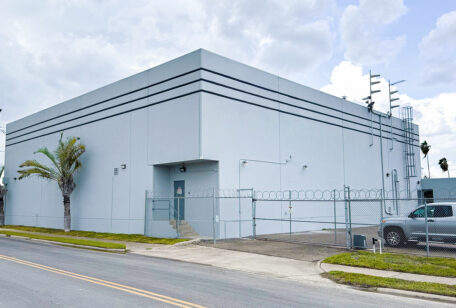
Explore MDC El Paso and Expand your Network Between the U.S. and MexicoThe MDC platform in El Paso
Interconnection hubs derive their value from participation.
MDC El Paso hosts a dense mix of international carriers, Mexican operators, and content platforms already exchanging traffic. That concentration enables route diversity, traffic optimization, and lower transit dependency.
Growth depends on the ability to expand without re-architecting.
MDC El Paso operates as a carrier-neutral platform designed to support distributed network strategies through:
- Access to international carriers and major Mexican operators
- Direct connection to MEX-IX, which has surpassed 500 Gbps in peak traffic
- Redundant international fiber crossings
- Tower colocation assets enabling wireless infrastructure alongside core carrier and content networks
As the western border corridor scales, the question is not whether traffic will grow. The question is where architectures can expand cleanly, without introducing fragility.
El Paso has positioned itself as one of those places.