


Alejandra Moreno
Why infrastructure is just the starting point and what really drives performance
Infrastructure is not the answer
When most people evaluate an Internet Exchange (IX), they start with infrastructure: port speeds, switching capacity, and data center locations. It’s a logical place to begin, but it’s also where many evaluations fall short. The underlying assumption is simple: better infrastructure should lead to better outcomes.
In practice, that assumption doesn’t hold. Infrastructure on its own doesn’t create value; it only creates the possibility of it. An IX can be built on high-capacity hardware, located in a premium facility, and still deliver little to no measurable impact on network performance. Without the right conditions around it, even the most advanced infrastructure remains underutilized.
Activity creates value
At its core, an IX allows networks to exchange traffic directly instead of relying on transit providers. The expected benefits, lower latency, reduced costs, and greater control over traffic, are well understood across the industry. However, those outcomes do not come from the infrastructure itself.
They depend entirely on whether the right networks are present and actively exchanging traffic. You can connect to a high-capacity port in a world-class facility, but if the networks that matter to your traffic are not there or are not peering, the impact will be limited. The infrastructure may be in place, but the value is not.
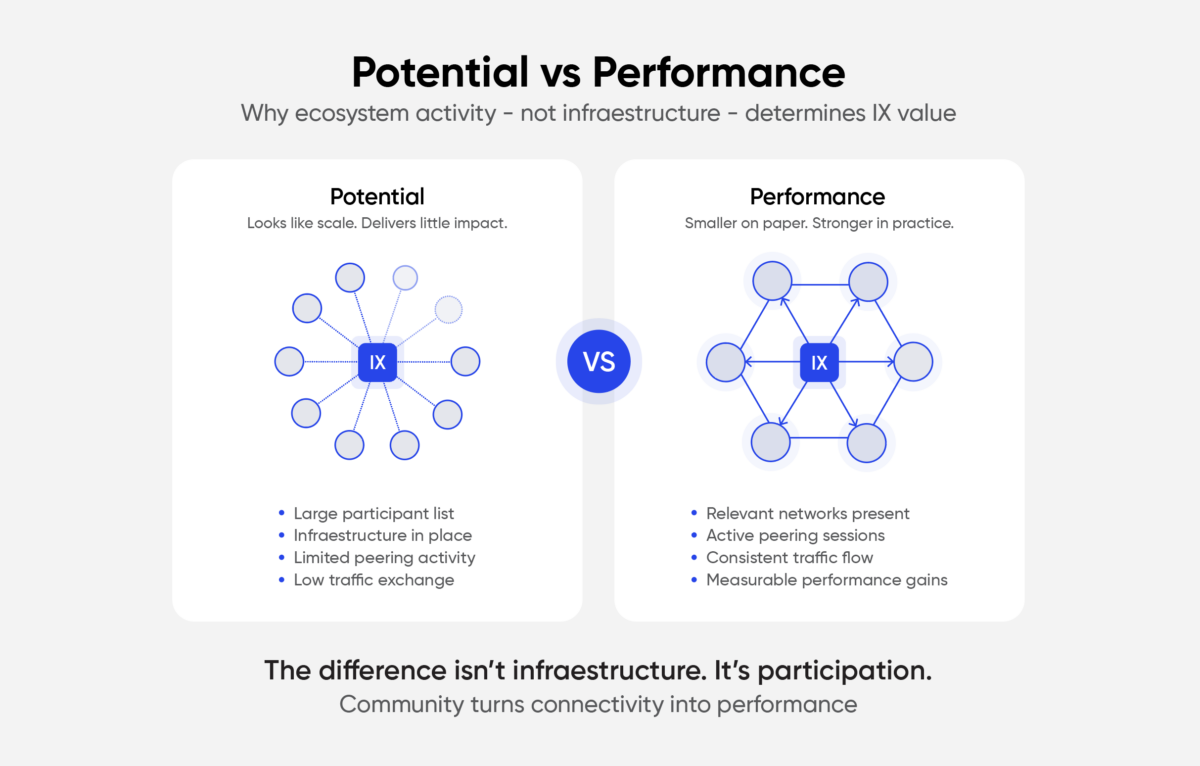
A high-performing IX is not defined by how many networks are listed, but by how many are active. It is the difference between potential and performance. In a mature ecosystem, networks are not just present, they are peering. Traffic is not just possible, it is flowing. And there is a meaningful mix of participants, including content providers, CDNs, cloud platforms, and regional carriers, all interacting in ways that generate measurable outcomes.
Potential is not performance
This distinction becomes clear when comparing different types of exchanges. In some IXs, dozens of networks appear on a participant list, and the infrastructure is fully in place. On paper, this suggests scale and capability. In practice, peering activity may be limited and traffic volumes relatively low, resulting in minimal impact for participants.
In contrast, a more effective IX may have fewer networks, but the right ones. These networks are actively peering, traffic is consistently flowing, and the ecosystem reflects how data is actually exchanged in the market. The result is tangible performance improvement.
The difference between these two scenarios is not infrastructure. It is participation.
Relevance beats scale
This is the principle behind MEX-IX. Located at the U.S.–Mexico border, where Mexican carriers, global content providers, and international networks naturally converge, MEX-IX was built with a clear focus: bringing together the networks that actually move traffic across the region.
Achieving this requires more than deploying infrastructure. It requires actively shaping the ecosystem so that content sources, cloud platforms, and carriers are not only present, but also peering in a way that translates into real performance gains. The objective is not simply to enable connections, but to ensure those connections are meaningful.
An IX is not just a place to connect. It is a place where networks interact, exchange, and grow together.
Trust requires validation
At the same time, not every IX ecosystem delivers the value it claims. In a growing interconnection market, it is common to see exchanges present strong participant lists that do not fully reflect actual activity. Networks may appear connected without actively peering, and infrastructure can create the impression of scale even when traffic remains limited.
For this reason, independent validation should be a standard step in any IX evaluation. Tools like PeeringDB provide a transparent, neutral view of any exchange, allowing operators to see who is connected, assess potential peers, and form a clearer picture of how active an ecosystem really is.
A useful question to guide that evaluation is simple: can you peer with the networks that carry most of your traffic? If the answer is yes and those networks are active, the IX will deliver value. If not, the impact will remain limited, regardless of how it is positioned.
Community is the differentiator
Infrastructure is the foundation, but it is not the differentiator. Infrastructure enables connectivity. Community creates value.
When choosing where to peer, the priority should not be how many networks are present, but how many are participating in a meaningful way. This means focusing on activity rather than availability, and validating claims through independent sources whenever possible.
That is the standard we apply at MEX-IX, and it is the standard worth applying to any Internet Exchange.